

- Where does moisture in compressed air come from?
- How does water vapor in the air turn into water?
- Compressed air dryers
Where does moisture in compressed air come from?
|
Compressed air is produced by compressing atmospheric air, which always contains a certain amount of water. This is not a problem as long as it remains in a gaseous state, i.e., as water vapor. However, compressed air can cool down on its way to appliances, and the water vapor partially or completely liquefies, which can cause significant damage: wear and damage to pneumatic tools and machines, clogging of valves and orifices, and pipe corrosion. This, of course, increases maintenance costs. Truly significant losses occur if production operations must be interrupted due to moisture in the distribution lines. Product quality can also suffer. What benefits will using dry air bring to your workshop or operation? Read the article Why use a dryer. |
 |
How does water vapor in the air turn into water?
The key is the dew point. The warmer the air, the more vapor it can hold without the vapor starting to liquefy (condense).
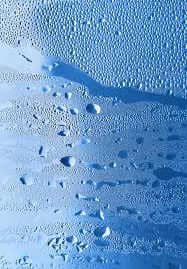
Water droplets begin to form in the air as soon as the air cools below a temperature called the dew point.
If air is at the dew point temperature, it is fully saturated with water vapor (relative humidity reaches 100%). When air cools below the dew point temperature, the water vapor in it turns into water.
However, the air dew point temperature is not always the same. It depends on how much water vapor is in the air, i.e., how humid it is. As you can see on the graph: if there is a lot of water vapor in the air, it condenses even at a higher temperature, so the dew point is higher. Conversely, if there is very little water vapor in the air, the air can be cooler without the vapor condensing. The dew point is therefore low.
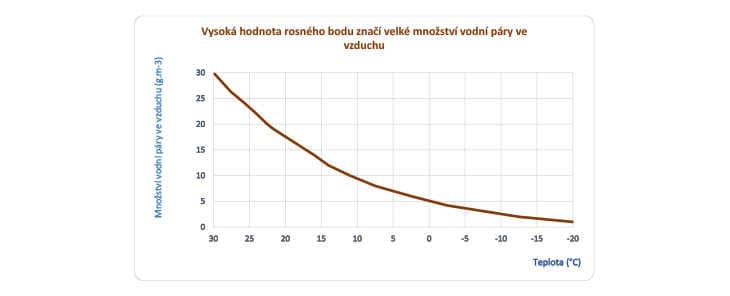
The goal of air drying is to reduce the amount of water vapor in the air so that the dew point reaches the desired value.
For compressed air, the term pressure dew point is used, which is the temperature at which vapor condenses at a given pressure.
To use compressed air at normal temperatures, it is advisable that its pressure dew point be 10 °C lower than the temperature in the operation or workshop.
Glossary of Terms
| Absolute humidity | The weight of water vapor in grams contained in a cubic meter (m³) of air. |
| Relative humidity | The ratio between the instantaneous amount of water vapor in the air and the amount of vapor the air would have at the same pressure and temperature at full saturation. It is given in percent (%). |
| Dew point (dew point temperature) | The temperature at which air is maximumly saturated with water vapor (relative humidity reaches 100%). If the temperature drops below this point, condensation occurs. |
| Pressure dew point | The temperature at which vapor in compressed air condenses at a given pressure. |
Compressed air dryers
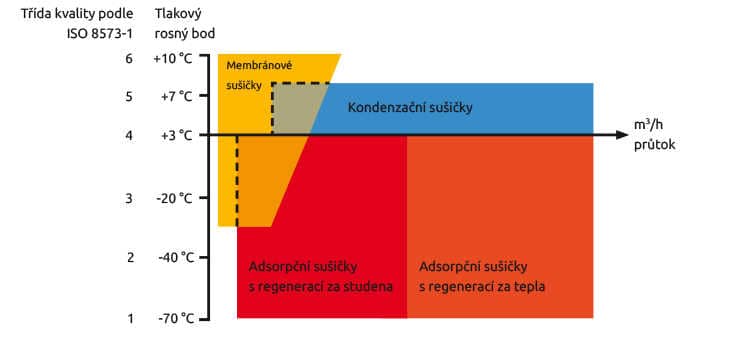
Operating areas of individual compressed air dryer types
@KATEGORIE@(/kondenzacni-susicka-stlaceneho-vzduchu-kompresoru/)(10,random)(slider)
Refrigerant compressed air dryers
In refrigerant dryers, the compressed air is first cooled to a temperature lower than the pressure dew point temperature. This causes the water vapor in the air to condense and turn into water, which is then removed from the air. Let's look at how a refrigerant dryer works.
1. Cooling air below the dew point, usually to a temperature of +3 °C or +5 °C
The air is cooled in a heat exchanger, where a refrigerant removes heat from the humid warm air. The exchanger has two circuits, for refrigerant and for air, so the air does not come into direct contact with the refrigerant. The refrigerant is forced into the circuit by a compressor and warms up as it passes through the exchanger due to the warm air; therefore, it must be cooled by a fan before entering the compressor. The refrigerant temperature is monitored by a temperature sensor and regulated.
Warm air enters the air circuit and is cooled in the exchanger to +3 °C or +5 °C. In some dryers, the air is pre-cooled before this cooling circuit by a stream of cold air brought from the dryer outlet.
2. Water removal
Air cooled in the exchanger contains water droplets, and these are removed from it in a cyclone separator. Cyclone or vortex separators are cylindrical vessels with a conical end. They use only gravitational and inertial forces, determined by the difference in density between air and water, for separation. The separators therefore have no moving parts, making them very low-maintenance. During the rotational airflow in the cylindrical vessel, centrifugal force causes water droplets to collect on the wall of the separator, from where they flow into the lower, conical part, and the water is drained via an electric valve.
|
Advantages of refrigerant dryers
|
Disadvantages of refrigerant dryers
|
For economical and reliable refrigerant dryer operation:
- Energy consumption can be reduced by placing a cyclone separator before the dryer.
- The dryer is protected from impurities by a filtration system.
Types of refrigerant dryers
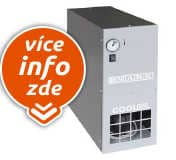
MARK Cool refrigerant dryers
|
 |

Atmos AHD refrigerant dryers
|
 |
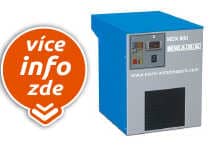
MDX refrigerant dryers
|
 |
@KATEGORIE@(/adsorpcni-susicka-stlaceneho-vzduchu/)(10,random)(slider)
Desiccant dryers
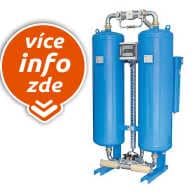
In desiccant dryers, the air is dried by flowing through a vessel filled with drying material that binds water. Water adheres to its surface or in its pores, and dry air exits the vessel. The drying material must be very porous; activated alumina (Al₂O₃) or silica gel (SiO2) are most commonly used.
A desiccant dryer has two towers, A and B, filled with drying material. Compressed air enters drying vessel A through a filtration system and flows through the drying material, which attracts water molecules, while dried air proceeds to the outlet. Within a few minutes, the drying material becomes saturated with moisture from the air and is unable to further adsorb. Therefore, the air is redirected by a valve system to the second drying tower B, where regenerated drying material awaits.
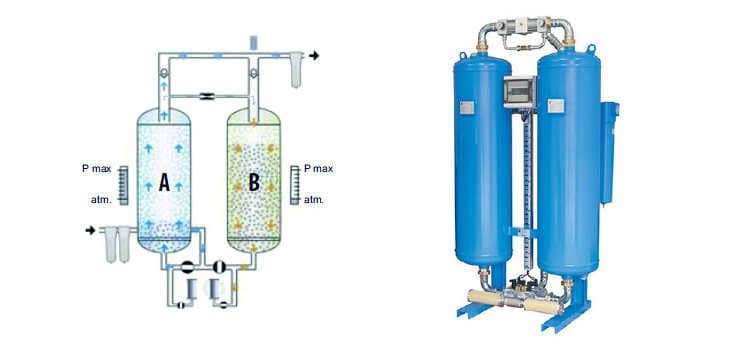
In tower A, it is necessary to regenerate the drying material as quickly as possible, i.e., rid it of water. Therefore, pressure is released from the tower into the atmosphere through a silencer, dragging water with it. Without pressure, water cannot stay in the drying material; additionally, the tower is purged with a small stream of dry air from tower B. Thus, tower A is ready for drying by the time the drying material in tower B becomes saturated. Compressed air is therefore alternately admitted into towers A and B.
|
Advantages of desiccant dryers
|
Disadvantages of desiccant dryers
|
Due to the ability to reach pressure dew point temperatures down to –75 °C, desiccant dryers are used where compressed air with very low moisture content is required, such as in the electronic, pharmaceutical, food, and beverage industries, and where outdoor temperatures drop below freezing.
Types of compressed air desiccant dryers
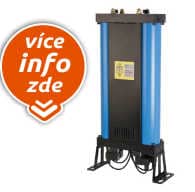
Omega Adry air dryers
|
 |
OMEGA BDRY air dryers
|
 |
@KATEGORIE@(/membranova-susicky-stlaceneho-vzduchu/)(10,random)(slider)
Membrane compressed air dryers
| Membrane dryers are composed of a bundle of hollow fibers (membranes), through whose interior humid compressed air flows from top to bottom (the image shows flow through a single fiber). During passage, moisture is forced out through the membranes, and air exits the fiber dry. A portion of the dried air (10 to 20%) returns outside the fiber and carries away moisture molecules. | 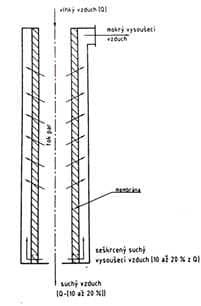 |
 |
Types of compressed air membrane dryers
MDRY air dryers
|
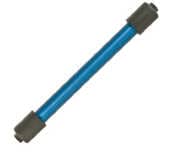 |
Membrane dryers require 10 to 30% of the supplied air quantity for their operation, depending on the pressure dew point value.